Professional Manuscript Analysis
Fix everything an AI can catch before your beta readers — or an agent — ever see a word. A panel of 40+ AI reader personas reads every chapter and returns a verdict that pulls no punches, in 48 hours.
40+
distinct reader
personas
Every
chapter read in full,
not a sampled skim
48h
from submission
to full report
$0
charged if your file
fails verification
Total Privacy
Before you hand your work to a human — whose opinion you'll obsess over, whose reaction you'll read into — get the analysis that can't be softened by politeness, social dynamics, or the desire to stay on good terms with you.
The entire pipeline is automated. Your words go into the analysis engine and nowhere else.
Your manuscript is used solely to generate your report, then the source is deleted within 30 days (or sooner if you ask). It is never used for training, benchmarking, or any other purpose. See our Privacy Policy for the full list of AI providers and retention details.
No human reads your manuscript — an automated pipeline does the work, your source file is deleted after delivery, and it is never used to train AI.
We confirm your file is a complete novel before your card is charged. Rejected files cost you nothing.
See It For Yourself
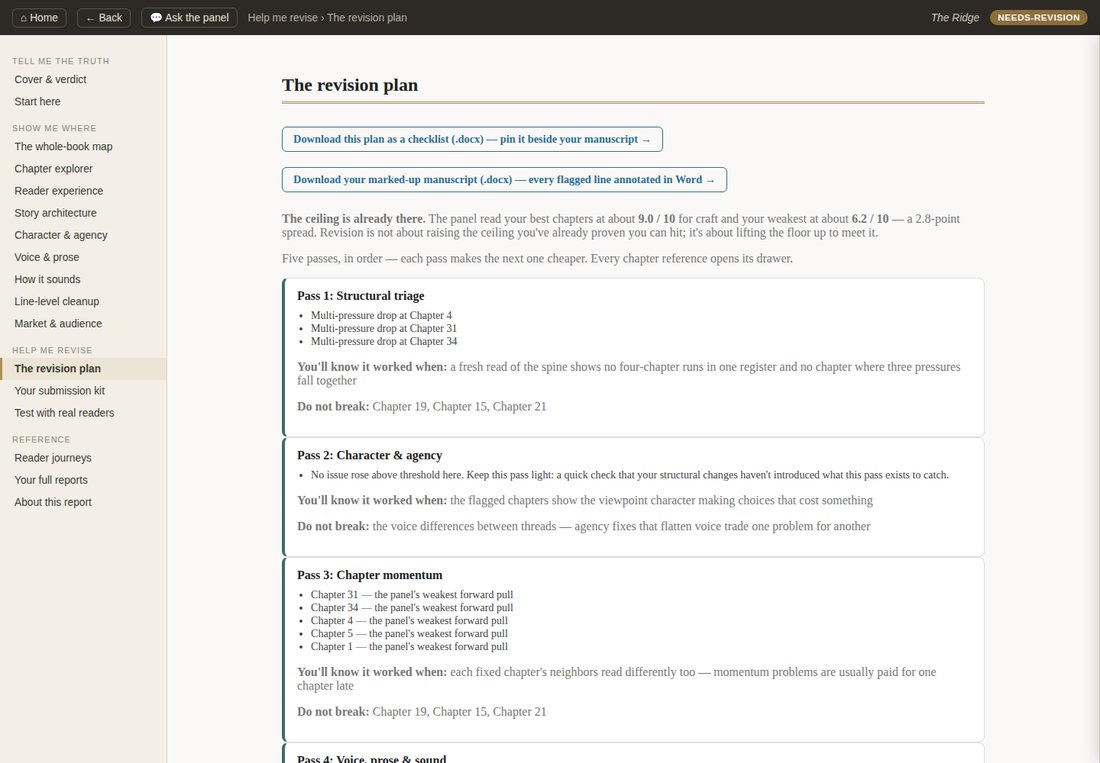
This is a complete, unedited NovelistAlpha report on a real unpublished manuscript — the founder's own novel, The Ridge, run through the exact pipeline you'd buy. The panel's verdict came back NEEDS REVISION. We publish it anyway, because the most important thing a manuscript review can do is say not yet — with reasons, page numbers, and a plan.
Verdict: Needs Revision — the founder's own book
Opens in a new tab — one self-contained file, exactly as a customer receives it.
What Makes This Different
Most "AI manuscript tools" spend a few minutes on a shallow skim and produce a pleasant, plausible read. NovelistAlpha runs for hours, reading every chapter through 40+ distinct reader-persona lenses — each with its own genre, demographic, attention, and industry orientation — so you get genuinely divergent viewpoints, not one model's defaults repeated dozens of times.
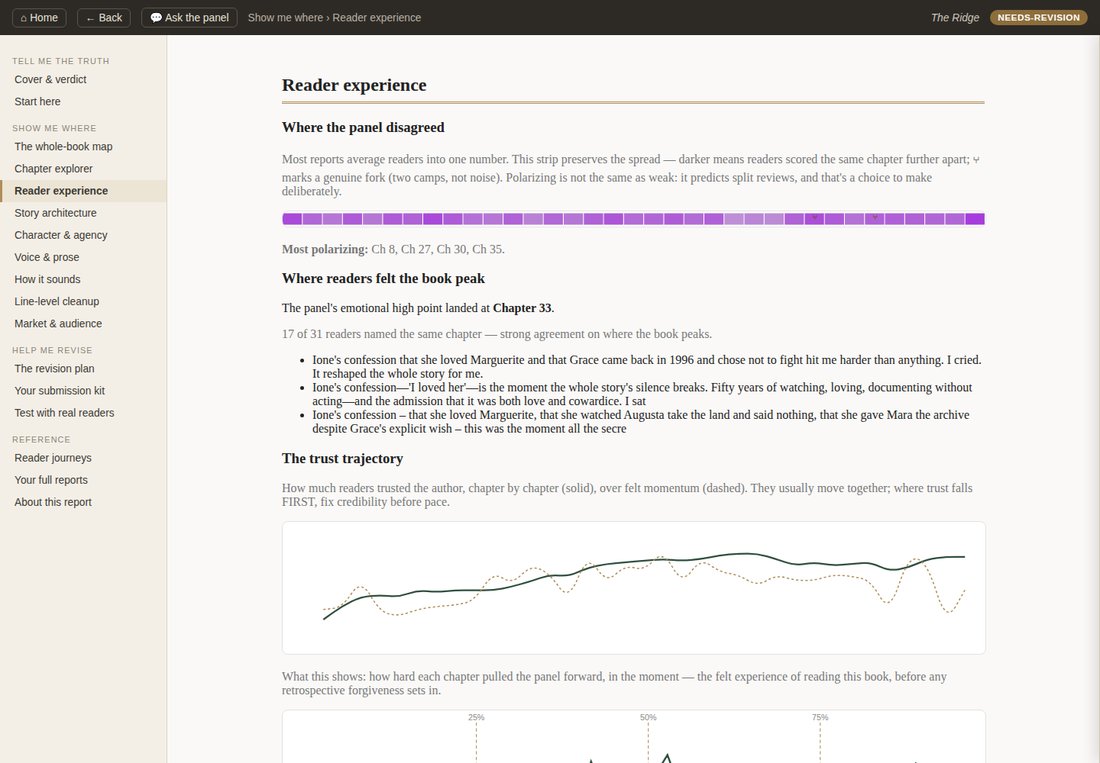
Where the panel agrees, you have a confirmed strength. Where they diverge, you have a real decision to make. That disagreement is the signal — and it only appears when the readers bring genuinely different lenses.
How the panel works
The honest question every serious writer asks: isn't this just one AI prompted to act like a crowd? No — and the difference is the whole point.
Every persona carries its own demographic background, reading-attention pattern, genre expectation, and industry role — a literary-agent reader sees a different book than a book-club reader or a jaded critic. The lenses are calibrated per genre, so a thriller panel reads nothing like a literary-fiction panel.
Each reader works through your whole manuscript on its own terms — not a sampled skim, not a single pass averaged into mush. That’s hours of reading per book, which is why the findings land on the exact page, not “somewhere in the middle.”
Where the panel converges, you have a confirmed strength or a real problem. Where it splits, you have a decision only you can make. A single chat tool can’t show you that — it gives you one voice, usually the one that tells you what you want to hear.
Disclosed, always: every reader is an AI persona — a simulated reader, never presented as a human, never a stand-in for a literary agent’s judgment. What you get is structured, repeatable honesty you can’t buy from friends (who soften) or a single chatbot (which flatters).
Why Authors Use This
A good beta reader's time is precious — don't burn it on the dropped subplot and the saggy middle you could have fixed first. Hand them a manuscript you've already cleaned up, so their attention goes to the things only a human catches, not the obvious notes you should have caught yourself.
You rarely get a clean second shot with the same agent. Your query has to land the first time. Run the analysis first. Know what the literary agent persona flags. Know what the acquiring editor sees. Go in prepared, not hopeful.
Your manuscript never leaves a secure pipeline. No human reads it — the analysis is fully automated, and we delete your source manuscript within 30 days (sooner on request). Get the brutal, honest assessment that a human reader would soften — before you expose your work to anyone who knows your name.
Not "the pacing felt slow in the middle." Instead: Chapter 7, the subplot introduced in chapter 3 goes unresolved, 15 of your 40+ reader personas dropped attention here — with the exact passage flagged. Actionable. Specific. Yours to act on.
Human beta readers self-censor. AI chat tools echo back what you want to hear. 40+ AI reader personas, each with its own demographic, genre, and industry lens will surface real divergence — the kind that tells you where your book actually stands.
Overused words ranked by frequency. Sentence length distribution. Chapter-by-chapter pacing scores. Dialogue percentage. The numbers that confirm what your instinct already suspects.
What You Receive
A single self-contained report — opens in any browser, no app, no account, yours to keep forever. Every page is generated from your actual manuscript: your panel reads your novel, your chapters, your words. Here's what's inside.
01
An 11-section editorial verdict with a clear readiness call — and when something must be fixed first, a "before this is ready" list right under the title. Agent and editor personas give an acquisition-interest read with specific reasons, and you see exactly where the panel agrees and where it splits.
02
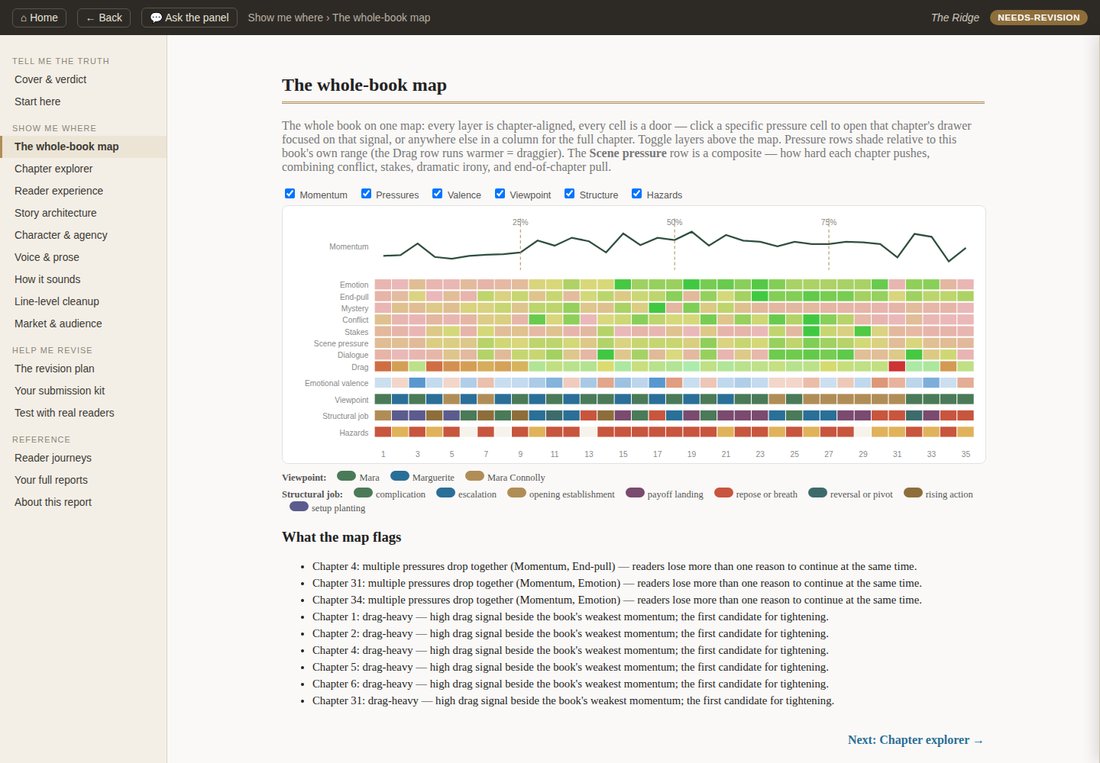
Your whole book on one screen: momentum, tension, and reader attention chapter by chapter — every column a door into what your readers said right there.
03
What the panel actually said, quoted: what landed, what lost them, the lines they remembered, and where they would have put the book down.
04
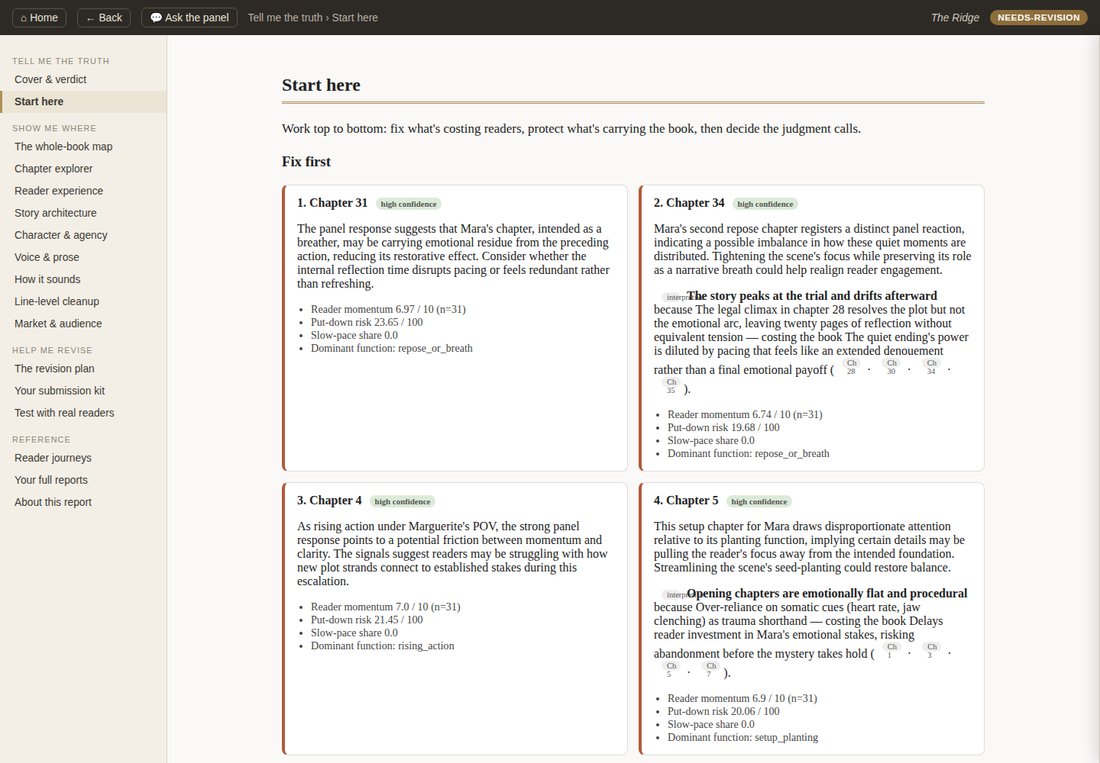
Prioritized fix cards — what to change, where, why, and how to verify it worked — plus a protect list for the things that are working and shouldn't be touched.
05
Per-character cards built from your own text, your voice at its best and worst quoted back to you, sentence-rhythm and dialogue analysis, and read-aloud hazards.
06
A one-time line-level cleanup map — typo candidates, name drift, repeated phrases, continuity flags — plus passages flagged where phrasing reads close to well-known published work or stock language.
07
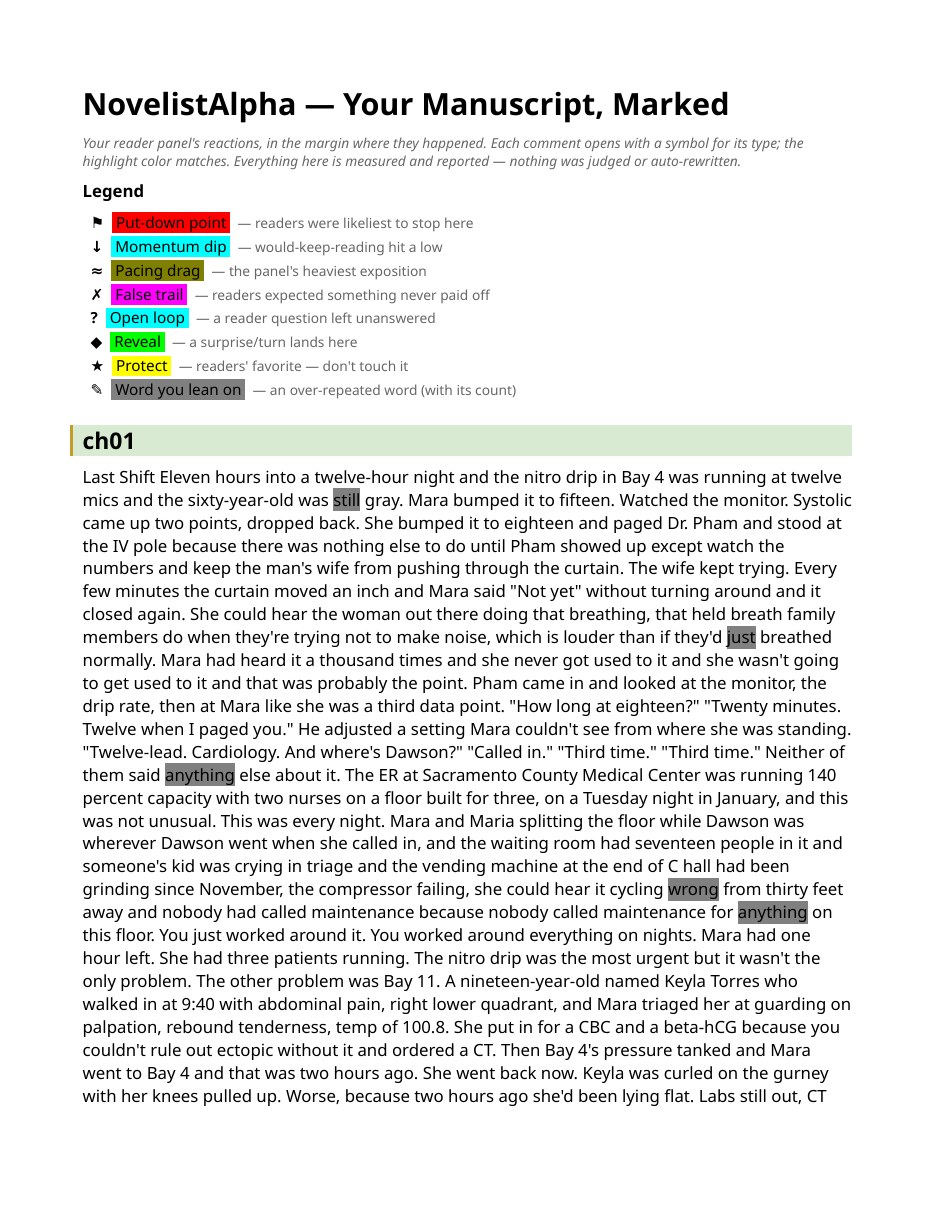
Your full manuscript returned with the panel's reactions in the margins, right where they happened — put-down points, momentum dips, false trails, open loops, and the words you lean on, with counts.
08
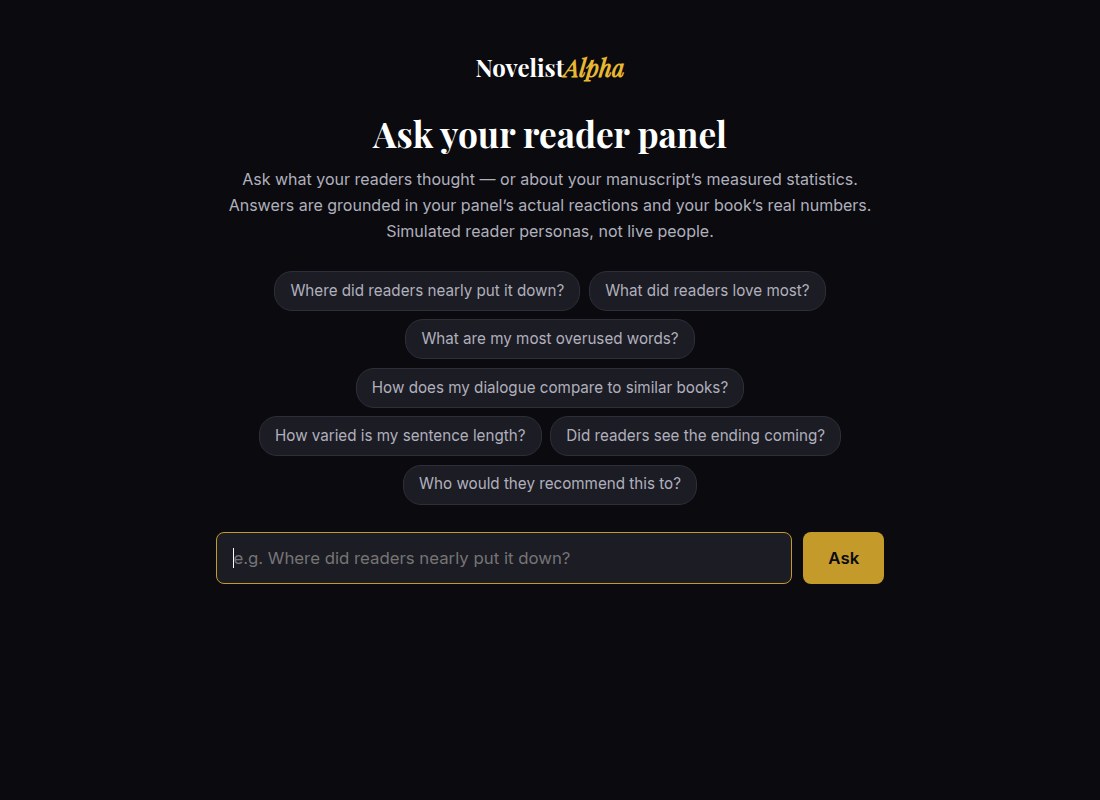
After delivery, ask your reader panel follow-up questions — "where did readers nearly quit?", "what did they love?" — and get answers grounded in their actual reactions and your book's real numbers.
The Reader Panel
Every profile is an AI persona — a simulated reader, not a real person. Each brings a different orientation — demographic background, reading attention pattern, genre expectations, and industry lens — so you get genuine divergence instead of one model's biases repeated. The panel is calibrated per genre: a thriller panel looks different from a literary fiction panel.
Industry
Literary Agent
Acquisition-interest read, comp titles, red flags, one-line pitch. The candid take on how your book positions.
Industry
Acquiring Editor
Structural notes, revision priority list, line-level concerns, publishability assessment.
Industry
Book Club Curator
Discussion potential, emotional resonance, word-of-mouth likelihood, book club fit score.
Industry
Bookseller
Shelf placement, hand-sell pitch, comparable titles currently moving, returnable risk.
General Readers
Dozens of Diverse Orientations
Varied demographics, reading habits, and attention patterns. Finish-rate prediction and chapter-level drop analysis.
Literary
Author Perspectives
Craft-level feedback from personas modeled on masters of the form — the standards your prose is measured against.
"Chapter seven is the problem. The subplot you open in chapter three never closes, and 15 of your reader personas disengage right here — page 142."Illustrative — the kind of specific, page-level finding the panel surfaces
Why This Exists
NovelistAlpha was built by a working novelist who wanted one thing he couldn't buy: a reader who would tell him the truth before an agent formed an opinion that would never be revised. Human beta reads take months and arrive softened by friendship. Chat AI praises everything. A professional edit costs thousands and still starts with problems a machine could have caught.
So he built the reading panel he wished existed — and ran his own manuscripts through it, on the same terms as everyone else. The system is engineered to be honest enough to say "not ready" to its own builder, because a review that can't say no is worth nothing.
Pricing
One flat price for manuscripts up to 300k words. No add-ons. No subscription. Submit your manuscript, we verify it's a complete novel, you pay once, and you receive the full interactive report within 48 hours.
You are not charged if your file fails verification. We confirm the manuscript is complete before your card is touched.
If the report doesn't give you actionable, specific feedback on your manuscript, contact us within 7 days for a full refund. No questions asked.
Full Manuscript Analysis
$189
one-time · no subscription · full manuscript · all genres
A developmental editor charges $1,500–$3,000 and takes weeks. A beta read takes months and arrives softened by friendship. NovelistAlpha is $189, delivered in 48 hours — and you're not charged unless your file passes verification.
Submit Your Manuscript — $189Verified before charge · 7-day money-back guarantee
Strictly confidential · No human reads your manuscript
Questions
A chat model reads a sample in one pass and tends to tell you what you want to hear. NovelistAlpha runs 40+ distinct reader personas progressively through every chapter — each with its own memory of your book — then separately reconciles their scores and maps where they agree and split. And the verdict can come back "needs revision." A review that can't say no isn't a review.
The panels are calibrated per genre, and the scoring system is tested against published commercial fiction in your lane — so the bar reflects books that actually sell, not an arbitrary rubric. The verdict also has teeth: measured prose statistics can hold the readiness label back no matter how engaging the story, so a polished plot can't hide rough pages.
We accept .docx, .epub, PDF, and plain text files. If your novel is in Scrivener, export as a single compiled .docx. We also accept a ZIP of individual chapter files.
Yes. Your manuscript is used solely to generate your report by an automated pipeline — no human reads it. During analysis, excerpts are sent to our AI processors under no-training terms where supported, and never used for AI training. We delete the source manuscript within 30 days of delivery (sooner on request); we keep your finished report so we can re-send it, unless you ask us to delete that too. See our Privacy Policy for the full vendor list and retention details.
All commercial fiction: literary fiction, upmarket women's fiction, thriller, mystery, historical fiction, romance, sci-fi, fantasy, and YA. The panel composition is calibrated per genre cluster.
No — it makes them more valuable. Run NovelistAlpha first to clear the structural and craft problems an AI can catch, then send your betas a cleaner draft so their irreplaceable human read goes to what machines miss: emotional truth, cultural nuance, whether they'd recommend it to a friend. We don't soften the verdict to protect a relationship — so you arrive at the beta read already knowing the obvious answers.
It's an AI agent-persona assessment: a candid acquisition-interest read — would a professional want to pursue this, with specific reasons. It reflects the professional bar a query has to clear — not a real agent's personal taste, and not a guarantee of representation.
If the report doesn't give you actionable, specific feedback on your actual manuscript, contact us within 7 days for a full refund. The guarantee is unconditional.